
Moravian Sugar Cake is something I'd heard of through the years, but didn't really think about until we moved to North Carolina. Every Christmas someone mentions going to the Moravian church to purchase cakes made by Dewey's in Winston-Salem. It happened again yesterday. Our neighbor dropped by with shortbread and mentioned she'd hoped to bring a Moravian Sugar Cake but couldn't get one. We thanked her for the shortbread and told her we'd try to to make it ourselves.
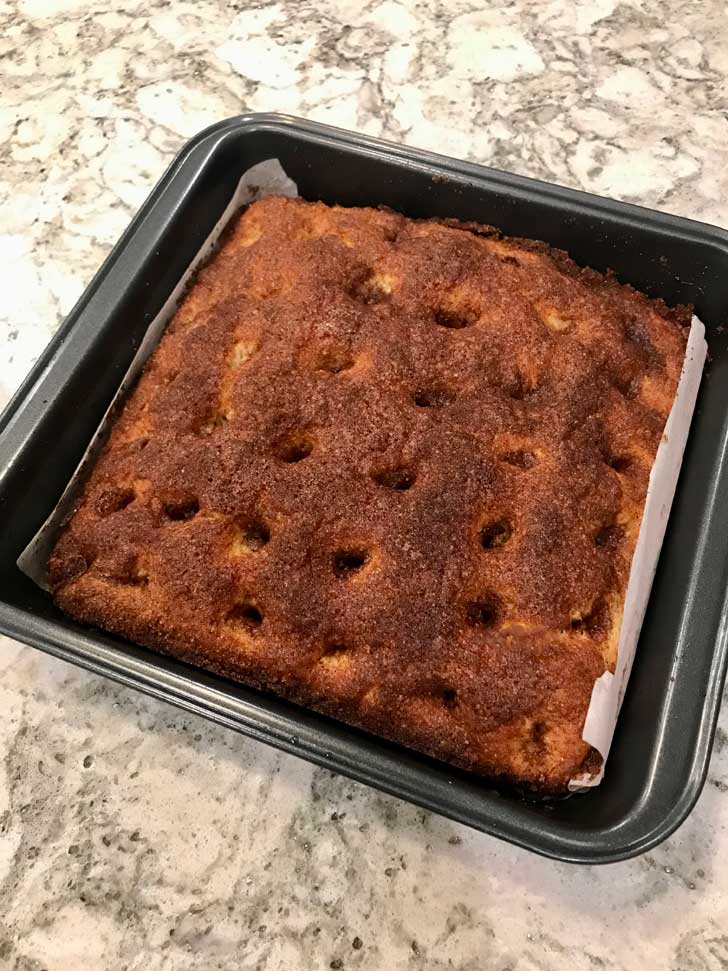
What Is Moravian Sugar Cake?
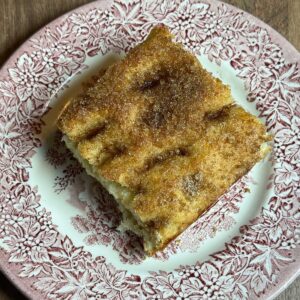
So what is Moravian Sugar Cake? I always associated it with stollen or a more time consuming pastry, but really it's just a very light textured yeasted coffee cake with crispy cinnamon sugar top. It's like soft and fluffy cinnamon rolls in cake form, but even easier because you don't have to roll and cut the dough. The only drawback to the recipe we chose it that it's so easy you'll want to make it over and over in a million different ways. Or maybe that's just me. This is a habit I need to break in 2023 -- making one thing and then trying to do it again differently. This is a good, solid recipe that doesn't need changes.
Classic Home Desserts Moravian Sugar Cake
The recipe is from Classice Home Desserts by the late Richard Sax who says the recipe was "unearthed" by Karyl Bannister of the Cook & Tell newsletter, which I'm slightly fascinated by. Looks like there is a book version of Cook & Tell which I wish I'd put on my Christmas list. But back to the cake. Sax describes Moravian Sugar Cake as "a deliciously moist yeast dough cake baked in a sheet pan and cut into large squares or rectangles". In the book there's a side note about happy accidents. It involves a cat and that's all I'll say. Lots of fun side notes in the Sax book.
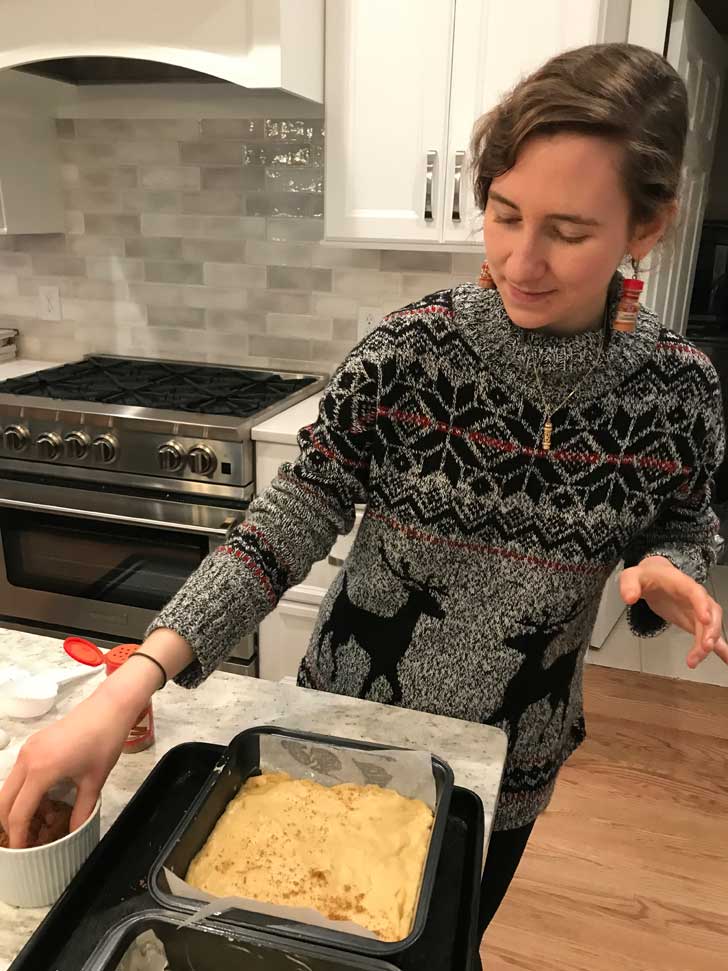
Moravian Sugar Cake Pan Size
In Classic Home Desserts, Richard Sax calls for a jellyroll or a 13x9 inch pan. Since we were keeping one cake and giving the other away, we divided the dough between two 8 inch square pans. We used two inexpensive metal pans and gave one of the cakes away right in the pan, so using 2 pans works well for holiday gifting. With 8 inch pans the cakes might be slightly thicker than some. We liked the thickness. Howver, if you only have one 8 inch pan and one 9 inch you could probably get away with using one of each.
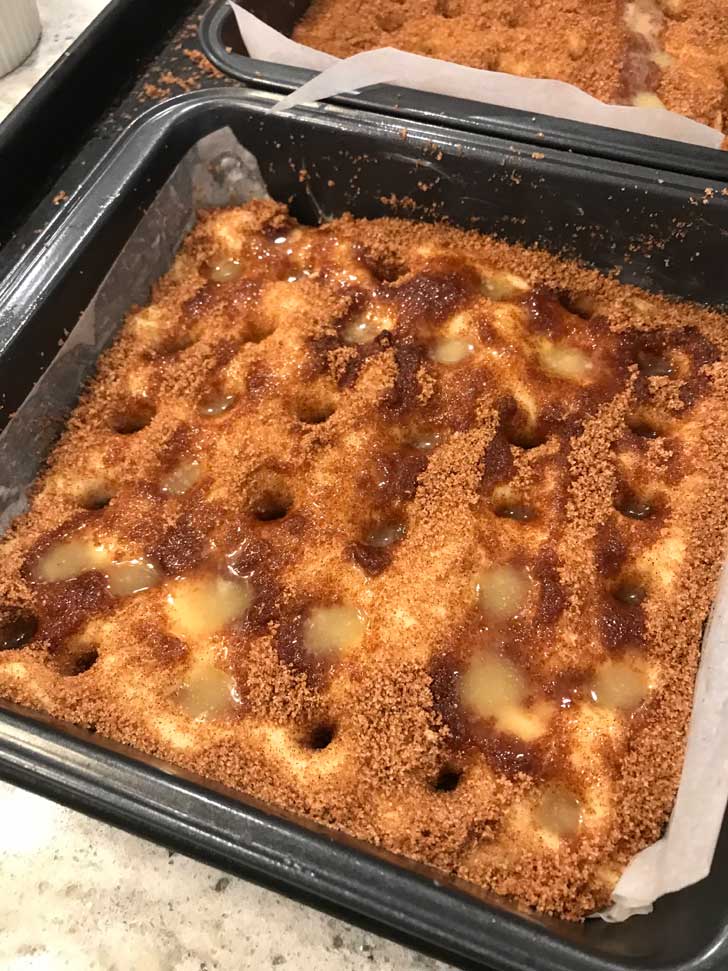
More Moravian Sugar Cake Madness!
We finally went to Winston Salem and had some authentic Moravian sugar cake. Meanwhile, a neighbor gave me her Moravian friend's recipe, which was very much like Richard Sax's, but with a few minor differences. So between trying the cake in Winston Salem and working off the Moravian recipe, I'm very happy with this one now. Here's what I did to Richard Sax's recipe.
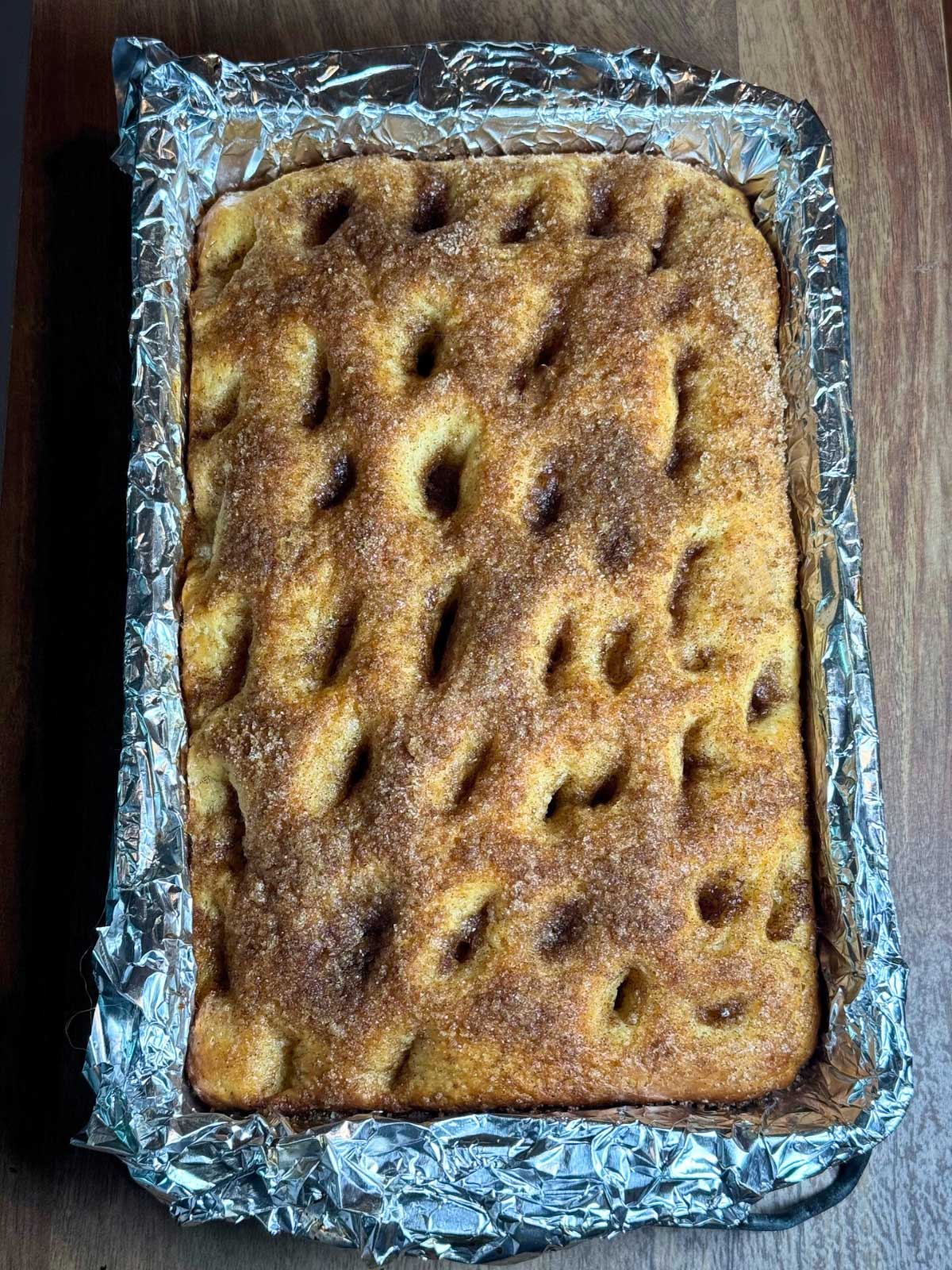
- The Moravian Sugar Cake in Winston Salem was thinner, almost the thickness of focaccia. Baking this recipe in two 7x11 inch pans or one 15x10 inch pan rather than two 8-inch squares will give you a thinner cake.
- Richard Sax only used ½ teaspoon of salt. Moravian recipes tend to call for Use instant mashed potato flakes. They're easy to work with, and it only takes a minute or two to make the half cup you need for the recipe. It's not a cheat, and it's Moravian approved.
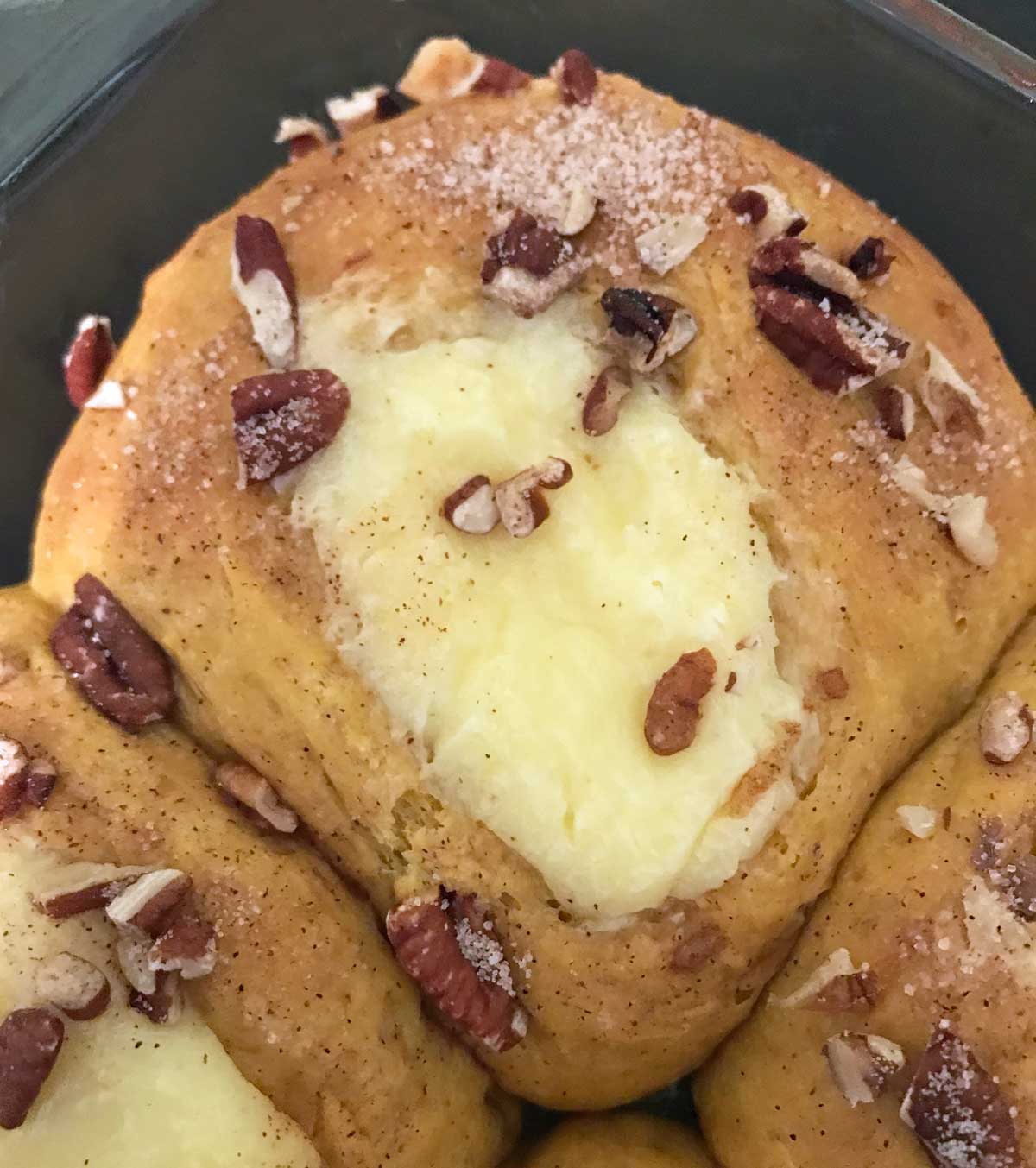
- To get a top that looks more like Dewey's, the famous cakes from Winston Salem, make the holes larger and elongate them a bit.
- Also, don't be too worried about over-proofing and let the cake rise long enough. While timing will still vary from kitchen to kitchen, over-proofing actually helps give the cake that "wavy" look because the wrinkles form as the dough collapses unevenly around the holes.
- Richard Sax uses less sugar in his dough than most, which keeps the crumb lighter and fluffier. There's enough sugar sprinkled over the dough to keep the cake plenty sweet. Given that, I didn't change the amount of sugar. What I did change was to use half brown and half white for the topping. The white sugar makes it a little more chewy.
- Using salted butter as the pour over butter also increased the flavor.
Recipe
Moravian Sugar Cake
Ingredients
- ½ cup lukewarm milk, divided use (114 grams)
- 4 ½ teaspoons active dry yeast
- 5 tablespoons granulated sugar, divided use (60 grams)
- 3 cups all-purpose flour (380 grams)
- ½ cup mashed potatoes (instant or unseasoned homemade)
- 2 large eggs at room temperature (100 grams)
- 6 tablespoons unsalted butter, melted and slightly cooled (84 grams)
- ½ teaspoon salt
Topping
- ¼ cup brown sugar (60 grams)
- ¼ cup granulated sugar (50 grams)
- 1 ½ teaspoons cinnamon
- 4 tablespoons butter, melted and cooled (I recommend salted) (56 grams)
Instructions
- Combine ¼ cup of the warm milk, the yeast and 1 tablespoon of the sugar in the bowl of a stand mixer. Let stand until yeast is foamy.
- Add the remaining 4 tablespoons of sugar, 1 ½ cups (half) of the flour, mashed potatoes, eggs, melted butter and salt and mix well by hand until you have a loose and sticky mixture.
- Add the remaining flour and continue mixing to make a shaggy dough. Put the bowl on the stand mixer stand and mix with the dough hook (paddle is okay, but the dough hook works well since this is thick) for about 2 minutes until smooth and just slightly sticky. It should cling to the hook and the bottom of the bowl. We're not trying to develop the gluten, so this is just a quick knead and the dough should still be very soft and sticky.
- Scrape dough from the sides of the bowl and push it all to the center, then cover and let rise for 1 hour or until doubled in bulk.
- Grease two 8-inch square pans or two 7x11 inch pans or one 15x10 inch pan. You can use metal pans or two disposable foil pans.
- Punch down the risen dough and divide it between the two pans (about 14.5 oz dough in each pan). Cover with greased plastic wrap and let rise until it puffs up quite a bit and comes almost to the top of the pan. Don't worry too much about over-proofing. If you used active dry yeast, this should take about an hour and a half.
- Dip your finger in some melted butter and poke dimples all over the bread, going almost to the bottom. For a more wavy look, elongate the dimples slightly.
- Mix together the brown sugar and cinnamon and sprinkle a little over half of this mixture evenly over the dough and into the dimples. Drizzle evenly with half of the ¼ cup of melted salted butter directing it into your holes. Let it drip down in there, then, then let stand for 10 minutes. Drizzle remaining butter over the top and sprinkle on all the remaining sugar.
- Preheat the oven to 375 degrees F.
- Bake for 20 to 25 minutes or until the internal temperature of the bread is around 195 degrees F or up to 200 F.
- Serve warm or let cool and serve later. You can also freeze it.
Anna says
Thanks Beenz! I have corrected it.
Beenz says
Surely six tablespoons (3 oz.) of butter should be closer to 90gm rather than 170gm.
Anna says
Sue, let me know if you try it! It may be the same type of cake, but there are a few different versions of it.
Taneka, take a second shot at it! It probably won't be worse than the "experience".
T. Martin says
I had an "experience" trying my hand at this cake years ago. Maybe time to try it again...
Sue says
Emma is looking so sophisticated! The earrings are a hoot!
I hope to make this soon! My paternal grandmother didn’t really bake but she would occasionally make a yeasted coffee cake. She never used a recipe and I wasn’t old enough to know to pay attention. I really want to try this to see if it’s similar.
Thanks so much for trying and sharing this.
Happy holidays!
Anna says
Kathy, I hope you like it. Merry Christmas!
Kathy says
I'm adding this to my baking list. It will be perfect for Christmas!